Winter Arc Day 1: The Ultimate Full-Body Activation Workout
Welcome to Day 1 of the Winter Arc.
If you’ve decided to start a 90-day journey focused on fitness, discipline, consistency, and self-improvement, today is where it begins.
You don’t need a gym membership, expensive equipment, or an hour of free time to get started. Day 1 is designed around a simple goal: wake up your entire body, raise your heart rate, and establish the habit of showing up.
This beginner-friendly, no-equipment workout combines cardio, lower-body strength, upper-body strength, and core stability into one simple circuit.
You will complete 3 rounds, followed by a 10-minute walk to finish the session.
The goal isn’t to destroy yourself on Day 1.
The goal is to finish Day 1 and come back for Day 2.
What Is the Winter Arc?
The Winter Arc is a popular 90-day self-improvement concept centered around using a defined period to build better habits and become more consistent with your goals.
For fitness, that can mean establishing a regular workout routine, improving your strength and endurance, eating more intentionally, getting enough sleep, and becoming more disciplined with your daily schedule.
But transformation doesn’t happen because of one difficult workout.
It happens because you repeat the right behaviors consistently.
That’s why Day 1 isn’t about pushing yourself to complete the hardest workout possible. It’s about creating momentum.
Winter Arc Day 1 Workout
Quick Overview
| Workout Detail | Day 1 |
|---|---|
| Workout Type | Full-body bodyweight circuit |
| Equipment | None |
| Rounds | 3 |
| Rest | 20 seconds between exercises |
| Difficulty | Beginner–Intermediate |
| Main Focus | Strength, cardio & core |
| Finisher | 10-minute walk |
The Circuit
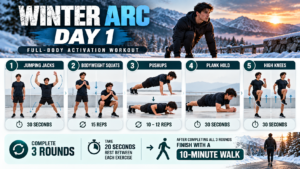
Complete 3 rounds:
- Jumping Jacks — 30 seconds
- Bodyweight Squats — 15 reps
- Pushups — 10–12 reps
- Plank — 30 seconds
- High Knees — 30 seconds
Rest: 20 seconds between exercises.
After completing all 3 rounds, finish with a 10-minute walk.
If you need additional rest, take it. Good form is more important than rushing through the workout.
1. Jumping Jacks — 30 Seconds
Jumping jacks are an easy way to start the workout and gradually raise your heart rate.
How to perform them
- Stand upright with your feet together.
- Keep your arms relaxed at your sides.
- Jump your feet outward while simultaneously raising your arms overhead.
- Jump back to the starting position.
- Continue at a controlled, consistent pace.
Don’t worry about going as fast as possible.
Focus on rhythm, breathing, and controlled movement for the full 30 seconds.
Beginner modification
If jumping feels uncomfortable, perform step jacks instead. Step one foot out at a time while raising your arms.
2. Bodyweight Squats — 15 Reps
Now move into your first strength exercise.
Bodyweight squats primarily train the quadriceps, glutes, and hamstrings while also challenging your core and lower-body stability.
How to perform them
- Stand with your feet approximately shoulder-width apart.
- Keep your chest comfortably upright.
- Brace your core.
- Push your hips backward and bend your knees.
- Lower yourself as far as you can comfortably while maintaining good form.
- Push through your feet to return to standing.
Your knees should generally track in the same direction as your toes.
You don’t need to force yourself into a particular depth. Control and comfortable range of motion come first.
Beginner modification
Use a chair behind you as a depth target. Lower yourself toward the chair and stand back up.
3. Pushups — 10–12 Reps
Pushups bring your upper body into the workout, working primarily the chest, triceps, shoulders, and core.
How to perform them
- Place your hands slightly wider than shoulder-width.
- Extend your legs behind you.
- Keep your body in a relatively straight line from your head to your heels.
- Brace your core and glutes.
- Bend your elbows and lower your chest toward the floor.
- Press through your hands to return to the starting position.
Avoid allowing your hips to sag or rise excessively.
If you can’t maintain good form for 10–12 standard pushups, modify the exercise.
Beginner modifications
Try:
- Incline pushups
- Knee pushups
There is no advantage to forcing standard pushups with poor technique.
4. Plank — 30 Seconds
After working your upper and lower body, it’s time to challenge your core.
The plank is an isometric exercise that trains your ability to maintain a stable body position.
How to perform it
- Place your forearms on the floor.
- Extend your legs behind you.
- Keep your elbows underneath or close to your shoulders.
- Brace your abdominal muscles.
- Squeeze your glutes.
- Keep your body in a straight line.
- Breathe normally while holding the position.
Avoid letting your lower back collapse toward the floor.
You also don’t need to hold your breath.
Beginner modification
Place your knees on the floor while keeping your core engaged and your body controlled.
5. High Knees — 30 Seconds
Finish the circuit with a burst of cardio.
High knees involve running or marching in place while lifting your knees toward your midsection.
How to perform them
- Stand tall.
- Begin running or marching in place.
- Drive your knees upward to a comfortable height.
- Move your arms naturally in coordination with your legs.
- Maintain a controlled but energetic pace.
You don’t have to bring your knees all the way to your chest.
Focus on maintaining good posture and consistent movement for the full 30 seconds.
Beginner modification
Replace high knees with marching high knees.
Lift one knee at a time while keeping one foot on the floor.
Complete 3 Rounds
You’ve now completed one round.
Take your 20-second transition breaks and begin again.
Your goal is:
Round 1 → Round 2 → Round 3
Don’t worry if your pace slows slightly during the second or third round. That’s normal as fatigue builds.
The priority is maintaining safe, controlled technique.
If you feel that you cannot maintain proper form, slow down or take a longer recovery period.
Finish With a 10-Minute Walk
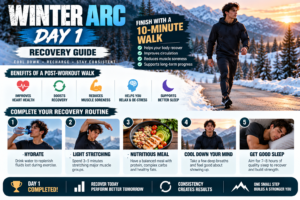
Once all three rounds are complete, finish the workout with a 10-minute walk.
You can walk outdoors, on a treadmill, or simply around your home or neighborhood.
Keep the pace comfortable.
This isn’t another high-intensity portion of the workout. It’s an opportunity to gradually transition away from the circuit and give yourself some low-intensity movement after exercising.
Use these 10 minutes to slow your breathing, hydrate afterward, and mentally reset.
You just completed Day 1.
Day 1 Beginner Version
If you’re completely new to exercise, you don’t have to perform the full version immediately.
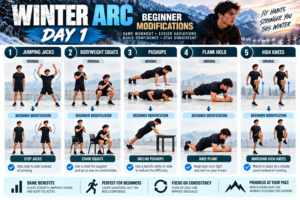
Try this modified circuit:
- Step Jacks — 30 seconds
- Chair Squats — 10–12 reps
- Incline Pushups — 8–10 reps
- Knee Plank — 20 seconds
- Marching High Knees — 30 seconds
Complete 2–3 rounds, depending on your fitness level.
As you become stronger, gradually work toward the full Day 1 routine.
Remember: modifying an exercise isn’t failing. It’s how you build toward the full movement.
How to Make Day 1 More Effective
The workout itself is only one part of your Winter Arc.
1. Focus on consistency
Don’t judge your progress based on how exhausted you feel after one workout.
Your biggest goal is to establish the habit of exercising regularly.
2. Prioritize form
Ten controlled pushups are more valuable than 20 rushed repetitions with poor technique.
3. Don’t ignore recovery
Your body needs time to recover and adapt.
Make sleep, hydration, nutrition, and recovery part of your overall routine.
4. Don’t try to do everything at once
The Winter Arc is a 90-day journey.
You don’t need to transform your entire lifestyle on the first day.
Build one habit at a time.
What to Do After Your Day 1 Workout
Once you’ve finished:
✓ Complete your 10-minute walk
✓ Drink some water
✓ Have a balanced meal
✓ Get enough sleep
✓ Track your workout
✓ Prepare for Day 2
Most importantly, give yourself credit for starting.
The hardest part of a 90-day challenge isn’t always the workout.
Sometimes it’s simply deciding to show up.
Today, you showed up.
Safety & Exercise Guidance
This workout is designed as a general fitness routine and isn’t a substitute for individualized medical or fitness advice.
If you’re new to exercise, start at an intensity that feels manageable and increase gradually.
Stop exercising if you experience significant pain, dizziness, fainting, unusual shortness of breath, or other concerning symptoms.
If you have an existing medical condition, injury, or specific exercise restrictions, speak with an appropriate healthcare professional before beginning a new workout program.
The Real Goal of Winter Arc Day 1
Day 1 isn’t about becoming a completely different person overnight.
It’s about proving to yourself that you can start.
Three rounds of a bodyweight circuit won’t transform your physique in a single day.
But completing Day 1 creates something much more important:
momentum.
Tomorrow, you’ll have another opportunity to show up.
Then another.
And another.
That’s how 90 days begin.
One workout. One habit. One day at a time.